
Explore the stories, technologies and achievements that make Tempur-Pedic® the most highly recommended mattress brand in America*.
Explore the stories, technologies and achievements that make Tempur-Pedic® the most highly recommended mattress brand in America*.
— by Tempur-Pedic on Aug 31, 2026
At some point during your search for the perfect mattress, you may have wondered “What is Tempur-Material®?” and “how does temperature-sensitive foam actually work”? Behind the comfort lies a surprising amount of science. This article breaks down what gives Tempur-Pedic® mattresses their signature support, pressure relief, durability, and long-lasting comfort.
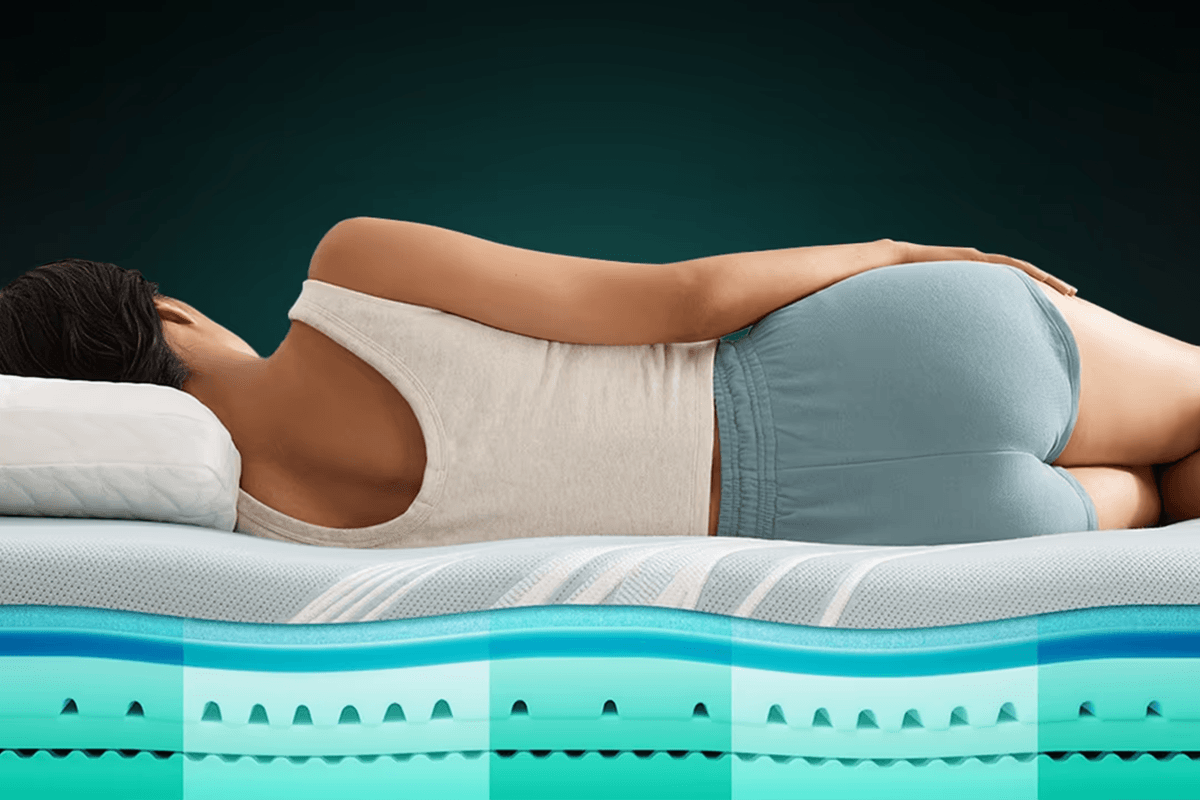
Tempur-Material is a proprietary form of viscoelastic foam based on research originally conducted by NASA to improve pressure distribution and impact absorption. Memory foam was invented by NASA-funded researchers seeking ways to keep test pilots cushioned and comfortable during long test flights (Memory Foam - NASA, 2016). The original NASA-era material is described as a viscoelastic material that slowly reacted to body weight, shape, and temperature, with soft, pressure-relieving properties and high-energy absorption (TEMPUR-Material️, Space Foundation, 2017). While the material used in today’s mattresses is a refined formulation, it's rooted in the same fundamental principles developed during NASA's early aerospace research.
NASA published the formula for viscoelastic technology in the 1980s, and Tempur-Pedic refined the material and manufacturing process for sleep products before introducing the first TEMPUR® mattress and pillow in 1991 (TEMPUR-Material️, Space Foundation, 2017).
TEMPUR-Material is engineered to respond to pressure and temperature, allowing it to mold to different body shapes with a high degree of precision. The material is heat sensitive and slow-reacting to body weight, shape, and temperature (The Tempur-Pedic Difference: One-of-a-Kind Materials, Tempur-Pedic, 2020). This adaptive behavior is what gives the material its distinctive ability to conform closely to the body, easing tossing and turning, while still providing consistent support.
TEMPUR-Material works by responding to pressure, with body heat influencing how quickly and how deeply the technology conforms. When pressure is applied, such as when you lie down, the material gradually softens and conforms exactly where force is greatest, allowing it to contour the body’s natural curves. TEMPUR-Material’s open cellular structure softens and continuously adapts as you sleep (How TEMPUR-Material is Different Than Memory Foam, Tempur-Pedic, 2020).
TEMPUR-Material's slow-response, viscoelastic properties also absorb movement instead of transferring it across the mattress surface. This "slow spring-back" characteristic helps reduce pressure points while delivering excellent motion isolation, minimizing disturbances between sleep partners and promoting more restful sleep (The Tempur-Pedic Difference: One-of-a-Kind Materials, Tempur-Pedic, 2020).
The term “viscoelastic” combines two key material properties that work together to create TEMPUR-Material's unique feel:
These respond where pressure is applied, move slowly rather than bouncing, and always return to their original form once the weight is removed. The material’s viscous properties are described as fluid-like, while its elastic properties are described as spring-like, with both working together to provide unmatched support, comfort, and adaptability (The Tempur-Pedic Difference: One-of-a-Kind Materials, Tempur-Pedic, 2020).
This dual behavior allows TEMPUR-Material to redistribute pressure over a larger surface area, rather than concentrating it at common pressure points such as the shoulders, hips, and lower back. The result is a balance of contouring and support that better adapts to the sleeper’s body, helping reduce stress on joints and improve overall comfort.
No, TEMPUR-Material is not the same as memory foam. While TEMPUR-Material belongs to the broader memory foam category, it differs from conventional formulations. Building on the original viscoelastic concepts developed decades ago by NASA, Tempur-Pedic has refined TEMPUR-Material into a highly consistent and precisely engineered technology designed for long-term comfort and performance. (How TEMPUR-Material is Different Than Memory Foam, Tempur-Pedic, 2020).
One key difference between standard memory foam and Tempur-Pedic's materials is density. TEMPUR-Material is higher-density with a more complex molecular structure than common foams, which increases durability and provides enhanced body conformance and pressure relief even after years of nightly use.
The important distinction is that TEMPUR-Material is a type of memory foam, but memory foam is not the same as TEMPUR-Material.
Who invented memory foam?
TEMPUR-Material is Tempur-Pedic’s proprietary viscoelastic technology. Memory foam was invented by NASA-funded researchers looking for ways to cushion test pilots during flights in the 1960s (Memory Foam - NASA, 2016). TEMPUR-Material️ is connected to NASA-era viscoelastic technology that later evolved into sleep products (TEMPUR-Material️, Space Foundation, 2017).
How is TEMPUR-Material different than standard memory foam?
TEMPUR-Material belongs to the broader memory foam category, but it is a proprietary material. Tempur-Pedic's one-of-a-kind technology evolved over decades and is different from standard or "commodity” memory foam found in many beds and household items (How TEMPUR-Material is Different Than Memory Foam, Tempur-Pedic, 2020).
Why does TEMPUR-Material feel different when you lie on it?
TEMPUR-Material is described as heat sensitive and slow reacting to body weight, shape, and temperature (The Tempur-Pedic Difference: One-of-a-Kind Materials, Tempur-Pedic, 2020). Body heat causes the material to soften and adapt through the night (How TEMPUR-Material is Different Than Memory Foam, Tempur-Pedic, 2020).
How does TEMPUR-Material help with pressure relief?
Viscoelastic foam can spread pressure across a larger contact area instead of concentrating it at specific points. A pressure redistributing foam mattress made of viscoelastic, temperature-sensitive polyurethane memory foam was associated with fewer pressure injuries than a nonpressure redistributing foam mattress among ICU participants in a controlled study (PLOS ONE, 2020).
Why is TEMPUR-Material often associated with motion isolation?
TEMPUR-Material is described as a slow spring-back foam, and motion separation is attributed to its combination of viscous and elastic properties (The Tempur-Pedic Difference: One-of-a-Kind Materials, Tempur-Pedic, 2020).
Sources
“Memory Foam.” February 11, 2016. Published by the National Aeronautics and Space Administration. Read the NASA article. Full URL: https://www.nasa.gov/image-article/memory-foam NASA states that memory foam was invented by NASA-funded researchers looking for ways to keep test pilots cushioned during flights and notes its later use in beds, couches, chairs, shoes, theater seats, and football helmets.
“TEMPUR-Material️.” November 3, 2017. Published by Space Foundation. Read the entry. Full URL: https://www.spacefoundation.org/space_technology_hal/tempur-foam This source states that NASA scientists developed a viscoelastic material in the late 1960s that slowly reacted to body weight, shape, and temperature, and that TEMPUR-Material️ was inducted into the Space Technology Hall of Fame in 1998.
“The Tempur-Pedic Difference: One-of-a-Kind Materials.” April 1, 2020. Published by Tempur-Pedic. Read the article. This brand source describes TEMPUR-Material as a heat-sensitive, slow spring-back viscoelastic foam with viscous and elastic properties that work together for support, comfort, adaptability, pressure point relief, absorption, and motion separation.
“How TEMPUR-Material is Different Than Memory Foam.” October 7, 2020. Published by Tempur-Pedic. Read the article. This source states that TEMPUR-Material’s open cellular structure adapts to weight, shape, and temperature, and that body heat softens the material as it adapts through the night.
Bai, Dorothy Li; Liu, Tsai-Wen; Chou, Hsiu-Ling; Hsu, Yeh-Liang. “Relationship between a pressure redistributing foam mattress and pressure injuries: An observational prospective cohort study.” PLOS ONE, vol. 15, no. 11, e0241276, November 9, 2020. Published by PLOS. Read the study. Full URL: https://journals.plos.org/plosone/article?id=10.1371/journal.pone.0241276 This peer-reviewed study of 254 ICU participants found that use of a pressure redistributing foam mattress made of viscoelastic, temperature-sensitive polyurethane memory foam was associated with a lower pressure injury incidence than use of a nonpressure redistributing foam mattress.
You’re using an unsupported web browser.
A list of the most popular browsers can be found below. Just click on an icon to visit the download page.
Your phone or tablet is using software unsupported by our website. To improve your shopping experience, please update your device to the latest version of iOS or Android OS.


